

Visual Effects Capstone Project
Short Film: Ansible
Annotated Workbook
Student: Andrew Welsh
Ansible | Science Fiction Short Film
Project Concept
The project concept of our visual effects capstone project was to create a science fiction short film which follows a character's journey of escape and pursuit. We aim to replicate realistic world physics within our film as well as produce highly detailed 3D assets and environments, rendering and composting image sequences to achieve a photorealistic aesthetic.
Research Question
How can a 3D-modelled environment affect the short film's inflight action sequences and direct the short film's storyline?
Logline
A lone space smuggler is driven into a lethal escape after stealing an ansible transmitter device from a terraforming mothership.
Tagline
Being caught triggers a fight and flight reaction.
Treatment
Location: Space Sector WE633 | Planet: Enotspac
Fraxon, an illegal space smuggler, attempts to steal an ansible transmitter device from a terraforming mothership. Fraxon is caught by a guard who raises the mothership's security alarm and attempts to take him down. Unscathed, Fraxon reaches the entrance to a cargo and maintenance hanger with two more guards standing by but are currently distracted by a remote control drone. Hijacking a starfighter, Fraxon descends to the planet Enotspac below, with the two enemy guard starfighter pilots now in pursuit. After entering the planet's atmosphere, a lethal dogfight commences with both enemy guard starfighters authorised to take down Fraxon's starfighter by any means necessary. Reaching the planet's surface, Fraxon leads the dogfight into a dangerous, high-speed chase, navigating through the planet's mountainous terrain. One of the enemy guard starfighters collides with the landscape, exploding instantly. Leaving the island's mountainous landscape, Fraxon and the remaining enemy guard starfighter fly outwards over the planet's open ocean. Fraxon performs an engine cut manoeuvre, taking down the last enemy guard starfighter. Debris from the exploding enemy guard starfighter in front, however, collides with Fraxon's starfighter's left wing, causing him to crash-land in the planet's open ocean. Recovering, Fraxon is alerted by the starfighters' barely functional radar and tracking system, which signals the rapid approach of enemy starfighters. Fraxon pulls out from underneath his seat a pair of binoculars to see the distant but rapid approach of five enemy guard starfighters on the ocean's horizon.
Ansible - Poster Design

Ansible - Pre-Production Pitch Presentation Slides
Ansible - Re-Previsualisation
Pre-Production Planning Refinement
Pre-Production Planning Refinement
Returning to the second semester of our capstone project, Jaden and I resumed shot list and post-production planning. Although our short film's shot list was finalised, edit cuts were made to reduce workload as well as improve narrative focus and maintain audience engagement. Revisiting the previsualisation, I selected and removed shot sequences from the short film's dogfight scene that, after reviewing, were not essential in progressing the short film's storyline. This was a suggested edit by visual effects course lecturer Ashlyn Koh, who explained how shortening the starfighter flight chase scene would maintain the intensity of the sequence as well as reduce workload.
Outside of university capstone projects, the runtime for feature film productions continues to increase. Short films entered at film festivals now very commonly push past fifteen or twenty minutes. Mainstream films in the 2000s averaged 106 minutes of runtime, whereas current productions now average 114 minutes.
Subsequently, average shot length duration continues to decrease. Films produced from the 1930s to the 1940s averaged 10 to 12 seconds, emphasising theatrical blocking and longer master shots. During the 1970s and 1980s, average shot length became five to eight seconds as cinematic language became more dynamic. Films produced after 2000 now average two to three seconds. This was influenced as filming and distribution formats changed as well as psychological cinematography techniques. James Cutting (a cognitive scientist and empirical researcher at Cornell University) studied and found that films released after the 2000s became mathematically structured to mimic the natural fluctuation of human attention spans following the mathematical pattern known as 1/f fluctuation. When creating the previsualisation for our film, I aimed to mimic similar trends, keeping shot lengths under five seconds in order to maintain pacing and intensity.
Referring to our team's previsualisation, I was able to decide and select shots able to be removed from the orginal edit to create the final cut of our short film. Miro Boards proved to be an effective creative planning tool for this process, as shot list sections were able to be removed, reordered, and changed in real time, collaboratively.
With our short film's final edit planned, our team was able to focus our planning and preparation towards filming all green screen shots next week. Jadens' friend Mani opted to play the main character Fraxon, with myself acting as the mothership guards.
Bibliography
DeGuzman, K. (2025, June 13). What is Previs — The Art and Process of Previsualization in Film. StudioBinder. https://www.studiobinder.com/blog/what-is-previs-previsualization-in-film/
What is Previs? | Previsualisation Software | Autodesk. (n.d.). https://www.autodesk.com/uk/solutions/previsualization-software
Bulut, S. (2014). CONVEXITY PROPERTIES OF a NEW GENERAL INTEGRAL OPERATOR OF P-VALENT FUNCTIONS. Mathematical Journal of Okayama University, 56(1), 171–178. https://doi.org/10.1177/0956797610361679
Miro Board - Shot List Planning Document


Virtual Production Studio Filming
Virtual Production Studio Filming
To capture the live-action plates required for our short film, our team recorded footage in both the virtual production studio and green screen studio located on campus at AUT.
The decision to film live-action within the virtual production studio was developed from the ability to capture real-life lighting and parallax effects straight out of camera. Short film projects filmed and produced using virtual production studios follow a reversed pipeline in terms of the order in which the film's production is structured. Filming takes place after all 3D assets, animation, and simulation effects are rendered.
Meeting with Virtual Production Studio technician Timothy Haryadi provided valuable feedback as well as suggestions on how our team could utilise the studio to its full advantages. Tim also explained the limitations of the studio and how we should prepare/choreograph select shots in order to avoid on-set as well as post-production problems.
Filming in the virtual production studio requires 3D scenes to be built out in Unreal Engine, using a specific project file with adapted project settings. Having modelled the 3D environment terrain mesh in Gaea before altering and arranging it in Blender 4.4, I transferred the 3D environment into Unreal Engine. Within Unreal Engine, I will continue to model and add environmental detail to the surface terrain. Unreal Engine's real-time rendering and lighting and particle simulations will support generating realistic science-fictional environments.
Understanding the virtual production studio space and how preproduction and postproduction will be structured around its filming advantages as well as limitations has positioned our team to undertake preproduction appropriately.
Bibliography
AUT University. (2024, August 5). Hollywood film technology now at AUT. AUT University. https://www.aut.ac.nz/news/stories/hollywood-film-technology-now-at-aut
Virtual Production Studio. (n.d.). https://autuni.sharepoint.com/sites/DCTFacultyOperations/SitePages/Virtual-P.aspx?csf=1&web=1&e=Q7vd3s&CT=1786936171507&OR=OWA-NT-Mail&CID=016bdef2-bfb3-b365-5cd6-8035b501702a&SI=NonSentItems&clickParams=eyJYLUFwcE5hbWUiOiJNaWNyb3NvZnQgT3V0bG9vayBXZWIgQXBwIiwiWC1BcHBWZXJzaW9uIjoiMjAyNjA4MDcwMTEuMTEiLCJPUyI6IldpbmRvd3MgMTEifQ%3D%3D&SLSync=N&cidOR=Client
Virtual Production Studio - Test Shoot Footage
Starfighter Cockpit Shots - Testing Session #1


Starfighter Cockpit Shots - Testing Session #2


Corridor & Hanger Shots - Testing Sessions


Fight Sequence - Behind the Scenes
Green Screen Studio - On-Set Filming


Green Screen Studio - On-Set Filming Timelapse
Guard Starfighter 3D Modelling & Texturing
Guard Starfighter 3D Modelling & Texturing
Modelling and texturing the Lead and Chase Guard Starfighter 3D assets was a task I had been greatly looking forward to but had delayed in our productions pipeline. The main character of our short film, Fraxon, hijacks and escapes from the mothership hangar onboard the Dragonfly Starfighter (modelled by Jaden). In pursuit, two fighter guards pilots chase after him using the remaining Guard Starfighters in the hanagar (modelled by myself).
The Engineer Juggernaut (a horseshoe-shaped alien starship vessel from the 2012 sci-fi horror film Alien: Prometheus) contributed to the design process of modelling the guard ship in our own science-fiction short film. Originally designed and created by Swiss surrealist artist H.R. Giger, the 130-metre-circumference-spanning spacecraft blends futuristic industrial mechanics with advanced organic biomechanical science-fictional design. H.R. Giger's work included sculptural as well as canvas-based pieces, the largest collection being exhibited at the H.R. Giger Museum renovated from the Château St. Germain in Gruyères, Switzerland.
Aspects I drew from Giger's work included the organic, smooth-surfaced forms often acting as a protective outer shell above more intricate mechanical components. I modelled a continuous organic panel mesh as the guard ships main structural form, beginning from a flat 2D plane before subdividing to manipulate to a curved form. I found the horseshoe shape to be effective in Alien Prometheus's flight scenes, as it communicated to the audience the level of advanced science fictional civilisation technology from the Mala'kak aliens. I adapted this design concept in my own starfighter design, giving it a more narrow, arrow-like form. Modifying this design concept gave the starfighter a more attack/pursuit-focused aesthetic compared to the Heliades-class Engineer Juggernaut vessel in Alien: Prometheus.
To create the Guard Starfighter 3D assets, I followed a workflow of modelling in Blender before texturing in Adobe Substance 3D Painter to then export and import into Unreal Engine for additional 3D asset creation/adjustments (cockpit glass, thruster effects, scene lights). I found modelling in Blender to be more effective, efficient, and accurate in creating the mesh, as its interface and nondestructive workflow allowed for more precise control over the starfighter’s 3D form and topology. Using a mirror modifier along the Y-axis of the scene meant I was able to model the starfighter’s mesh to perfect A-symmetry. This resulted in a higher quality 3D asset as well as improved time efficiency.
Another useful 3D modelling modifier within Blender's workflow was applying a subdivision surface modifier to the starfighter's 3D meshes. This provided nondestructive alteration of each individual mesh's polygon count/resolution; determining surface/form smoothness as well as performance/optimisation control.
With the lead and chase guard starfighter 3D assets modelled and textured, animating the flight paths during the dogfight action sequences of our short film can now commence. Filming in the virtual production studio also requires the finalised animation of each starfighter 3D asset, as during certain shots, the leading/chasing starfighter is visble in frame.
Bibliography
Prometheus: The Derelict and the Juggernaut. (n.d.). https://alienexplorations.blogspot.com/2012/09/the-derelict-and-juggernaut.html
HR Giger Museum. (n.d.). HR Giger Museum. https://www.hrgigermuseum.com/
Nyfa. (2022, November 15). How H.R. Giger changed the way we see aliens - NYFA. NYFA. https://www.nyfa.edu/film-school-blog/h-r-giger-changed-way-see-aliens/
Ansible Mothership & Starfighter Design Mood Board

Guard Starfighter Design Concept Sketches


Guard Starfighter 3D Modelling Process


Guard Starfighter UV Unwrapping & Baking Process


Guard Starfighter Texturing Process


Starfighter Thruster Exhaust Niagara System

Guard Starfighter - Thruster Exhaust Demo
Dragon Fly Starfighter - Thruster Exhaust Demo
Guard Starfighter - 3D Asset Turntable
Planet Enotpac Environment Detail
Planet Enotspac Environment Detail
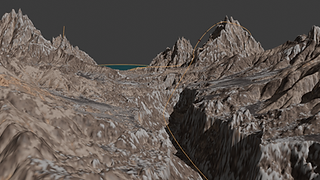
After modelling and generating the 3D environment terrain mesh during the first semester, I moved onto adding environmental detail to the landscape.
When modelling the 3D terrain in Gaea, my aim was to create an expansive mountainous field of islands which provided the setting for the short film dogfight scene to take place. Creating alpine environments with high elevational changes helps to build tension within the short film. This is caused by evolutionary psychology hard-wiring our brains to react strongly to environments that challenge our sense of scale or safety. Psychologists call this the sublime effect, which triggers a mix of awe and astonishment as well as danger or uncertainty.
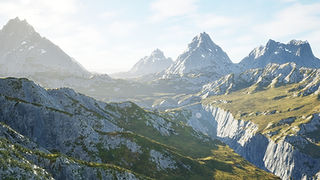
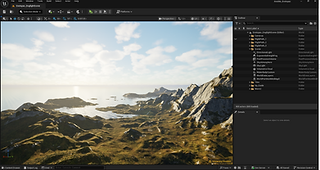
To determine the most suitable approach for applying 3D environmental detail/texture to the environment's surface mesh, I researched different techniques and approaches able to be carried out within Unreal Engine 5.6.1, including returning to Gaea to configure environment detail texture maps to be reapplied to the existing environment mesh or building out environment details using collections of meshes and distributing them across the terrain using Unreal Engine's landscape brush tools. Following this research, I found a landscape and environment plug-in commonly used amongst digital 3D artists to create the environmental detail which follows a node-based non-destructive workflow. MW Landscape Auto Material reads and interprets terrain height field maps and provides digital artists a vast array of settings and constraints, allowing full customisation over the environment's detail and appearance.
Adding and adjusting multiple layers of environmental detail to the terrain's landscape allowed for the setting of the planet. Enotspac to reflect the dogfight scene's envisioned visual style, intensity, and suspense within a mountainous, science-fictional landscape.
Bibliography
Van Wyk, A. (2018). Close encounters of the sublime kind: A study of the science fiction sublime in contemporary film [Master's dissertation, University of Pretoria]. UPSpace. https://repository.up.ac.z/items/4dbf98e4-b5db-4d55-9e5a-027ae766d6f9
Nicole. (2025, September 10). What is Mountain Film Theory? BeverlyBoy Productions. https://beverlyboy.com/filmmaking/what-is-mountain-film-theory/
Landscape Material | MW Landscape Auto Material. (n.d.). Fab.com. https://www.fab.com/listings/6602874e-ef24-48c9-9055-a7ac07384696?lang=en
Enotspac Environment Design Mood Board

Enotspac Landscape Wireframes


Enotspac Terrain Material Detail Parameters



Dogfight Scene Animation
Dogfight Scene Animation
Animating the final motion of the 3D assets within our short film was built upon and refined from animation tests made during the pre-production phases in Semester 1. Animation tests also served as content towards our short film previsualisation.
I learned through reading the behind-the-scenes of the Disney production SOLO: A Star Wars Story involving the animation process behind animating the freight train in the The Train Heist scene. Set in a futuristic, grunge-adapted science-fictional world, the animation team (supervised by Chris Lentz) decided a slower-moving train felt more dangerous and reality-grounded. The slower speeds also allowed for and provided the platform for more technical action sequences to be played by the actors during combat sequences.
As I had designed the 3D landscape to also be highly mountainous with drastic elevational changes, I implemented this animation decision into our own short film. I modelled a motion path (also used in SOLO: A Star Wars Story animation process) to navigate through the 3D environment. I planned this route to utilise the 3D terrain's landscape to the most cinematic potential, keeping distances as close to the surface mesh as possible (aiding to low lenience for error – elevating audience anxiety), choregraphing tight flight manoeuvres (showcasing high level piloting skills – heightening the dogfight chase scenes intensity), and minimising extended straight line flight paths (losing action sequence rhythm and build up).
A challenge faced was learning to reduce the number of keyframe inputs to the starfighter's animation. I learned this after progressing further in the timeline; multiple keyframes segmented in-between two key/major keyframes added jitter or inconsistent motion, whereas inputting two major keyframes provided smoother playback as well as greater control over the starfighter's speed curves.
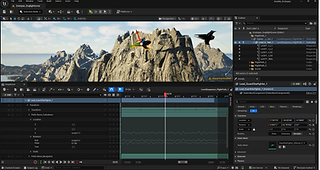
To further add realism to the starfighter's animation, I created additive transform animation layers (location and rotation), overiding with Perlin Noise parameters to replicate real-world flight physics I observed from fighter jet footage found online. The first additive layer stimulated turbulence experienced from high-speed flying (constant jittering/shakes), and the second focused on causing each starfighter to deviate from the shared flight paths within the scene.
With the final animation of the starfighters' dogfight chase scene completed, our team can now commit to finalised shot frame ranges and composite live action footage, visual effects renders, and sound effects accordingly.
Bibliography
Frei, V. (2018, June 7). SOLO – A STAR WARS STORY: Rob Bredow (Overall Visual Effects Supervisor & Co-Producer), Patrick Tubach (Visual Effects Supervisor) and Matt Shumway (Animation Supervisor) – Industrial Light & Magic. The Art of VFX. https://www.artofvfx.com/solo-a-star-wars-story-rob-bredow-overall-visual-effects-supervisor-co-producer-patrick-tubach-visual-effects-supervisor-and-matt-shumway-animation-supervisor-industrial-light-magic/
Charles Flynt. (2023, October 10). Unreal: Creating an animated fly through [Video]. YouTube. https://www.youtube.com/watch?v=sOi7S0b_0Tc
Digital Artistry. (n.d.). https://www.thedigitalartistry.com/insights/mastering-the-art-of-smooth-animation-a-comprehensive-guide
Pre-Production Animation Tests
Mothership Hangar Scene - Take Off Animation
Dogfight Scene - Spline Flight Path Animation


Starfighter Animation - Perlin Noise Channels
Mothership Hangar Scene - Take Off Shot Sequence
Dogfight Scene - Starfighter & Camera Animation
Wave 2 Scene - Binocular Shot
Wave 2 Scene - In Formation Shot
Mothership Hangar Lighting Design
Mothership Hangar Lighting Design
After building out the mothership 3D scenes (the corridor network Fraxon navigates during the first scene of the short film and the hangar he then later escapes from using a hijacked starfighter), I progressed to lighting design to illuminate the 3D scenes. Starting from a downloaded sci-hangar 3D asset from Sketchfab, including the main structure, materials, and textures, I added additional meshes to build out the scene further, making the hangar space feel as if it was a real working space station/mothership with frequent arrivals/departures and cargo haul/delivery, with servicing/maintenance work taking place within the hangar. Implementing these additional assets also provided more surfaces and forms for light to illuminate, reflect, and cast shadows onto, creating a more cinemetic final composition.
During pre-production stages in the first semester, I compiled visual references for lighting and atmosphere considerations as well as potential colour palettes. Star Wars Battle Front II is a action shooter video game developed by DICE and published in 2017 by Electronic Arts. During this time, I played Star Wars Battle Front II extensively for most of 2017 and revisited it last year. Aside from the gameplay, the low saturation colour tone and high-density atmospheric environments were attributes I felt were successful in contributing to the game's visual appearance.
Following lower colour saturation values when creating assets for our short film was a design decision influenced by playing Star Wars Battle Front II. I noticed how real-time rendering can lead to brighter, more saturated colours appearing harsh or overly exposed. Combined with high-density atmospheric properties, I also created similar environments in both the mothership and planet Enotspac scenes using Unreal Engine's post-process volume to configure world lighting and rendering settings.
Particular works used as reference/inspiration include Evan Yovanovich’s contributions to creating the Fondor Hanger in Star Wars Battlefronts' single-player campaign. I aimed to replicate certain colour palettes as well as the high amounts of contrast between light and shadowed areas. Creating a high-density atmosphere (exponential height fog) allows for larger differences in lighting as the light particles refract less, preserving shadowed areas.
Using Unreal Engine's light assets, I positioned, scaled, and configured light properties to illuminate the scene. I approached this task into two levels of lighting, beginning with the main light source and scene exposure, with secondary detail lighting supplementing/supporting this. For main light sources, I used rectangular lights, as these allowed large surface areas to be lit evenly. For finer detail lights, I used point lights and adapted their source and fall-off radius (sometimes adapting to become non-spherical) and positioned these to match the mothership hangar's 3D mesh. Underlying this lighting setup, directional lights and sky atmosphere lights were also worked on to complete the scene's science-fictional mothership hangar lighting setup.
As I was responsible for building out each of the scenes and 3D environments for our short film, ensuring these met our group's visual composition goals (lighting, colour palette/tone, and spatial/scale accuracy), as well as scene functionality for filming in the virtual production studio (project and file management, virtual camera setup, level sequencing and animations, studio lighting, and rendering), was important to deliver, as this provided the base layer of our project's workflow.
Bibliography
5 tips for lighting Sci-Fi. (n.d.). Panavision. https://www.panavision.com/highlights/highlights-detail/5-tips-for-lighting-sci-fi
Silverman, C. (n.d.). Unreal Engine 5 Lighting Fundamentals [Video]. The Gnomon Workshop. https://www.thegnomonworkshop.com/workshops/unreal-engine-5-lighting-fundamentals
Fondor Hanger - Star Wars Battlefront II. (n.d.). Evan Yovanovich. https://evanyo.artstation.com/projects/lkbDk
Brooks, D. (n.d.). The making of Star Wars Battlefront II. StarWars.com. https://www.starwars.com/news/the-making-of-star-wars-battlefront-ii
Mothership Corridor & Hanger Layout Development


Star Wars Battlefront II - Fondor Hanger


Mothership Hanger - Scene Lighting Mock-Up


Mothership Hangar - Lighting Design


Mothership Corridor - Lighting Design


Ansible Sound Design
Ansible Sound Design
With the final edit of our short film assembled, sound design was the final stage in our short film's production. The section of the short film I built the sound effects for was from when Fraxon climbs inside the cockpit and begins initiating the starfighter's start-up sequence. However, when transferring my sound effects work to Jadens master copy of the project, unfortunately, a lot of my sound design tracks were lost and/or replaced.
From experience of previous visual effects projects, I have learned how the sound design of media significantly impacts the audience's perception of immersion, realism, and theatrical reaction. I have also learned how sound design is simply a measure of how far you desire or are willing to push the audio tracks to obtain a satisfactory result. Tuning your ear to identity, replicate, and tune/adapt/build sound effects is a skill I believe I have been able to develop further undertaking the sound design for our short film, as our project's visuals, screenplay, and acting demanded higher levels of realism.
When equalizing and keyframing volume changes of the audio tracks, I aimed to match real-world volume levels to create a true-to-life dynamic range. The risk in approaching sound design in this way is the possibility for lower-volume tracks to be lost/unheard during playback while louder tracks exceed comfortable viewing volume levels. However, as our team's goal was to create a short film with maximum immersion and cinematic impact, mixing our films' audio levels to a high dynamic range was suited to this.
A process I enjoy is sourcing and layering multiple audio tracks and adjusting the volume and frequency parameters to build the final result of one sound effect. This was a technique used in much of the sound design, as (when utilizing the internet's best “free tier” sound effects), it is very rare to source a singular track that delivers the complete sound you need. Layering multiple tracks to fill out the complete frequency, timing, and sound dynamics for each shot contributed to the film's realism and complemented the visual effects our team had worked to create on screen.
Another technique I applied in our short film's sound design was aligning the audio tracks to match the spatial position and relation to the camera so as to simulate a 3D soundscape. The timeline position of tracks helped to achieve this, but I found manual adjustment and animation of the audio tracks' volume levels further helped to match the audience's spatial perspective in relation to the action taking place on screen.
Completing the sound design for significant parts of our short film run time was immensely satisfying, as I felt I was able to develop my audio and sound software skills further (an area of film production I consider to enter after graduating). One condition I noticed, however, was the difference in volume levels when playing from external speakers, which caused the lower volume tracks to be drowned out. Testing audio output through a selection of devices is a consideration I will put towards future projects.
Bibliography
Understanding various elements of sound design in a film and their effect on the audience. (2024, October 23). APAC. https://apac.edu.au/blog/elements-of-sound-design-in-a-film/
The impact of sound design on storytelling in film and series. (n.d.). https://hivaristudios.com/blog/the-impact-of-sound-design-on-storytelling-in-film-and-series
Pixflow. (2025, November 11). The complete guide to cinematic sound effects. Pixflow Blog. https://pixflow.net/blog/the-complete-guide-to-cinematic-sound-effects/
Corporation, B. (2026, August 26). Science fiction sound effects : A complete guide to sci-fi SFX. Bluezone Corporation. https://www.bluezone-corporation.com/blog/science-fiction-sound-effects
Carlsson, S. E. (n.d.). the machinery aimed at the ear. https://www.filmsound.org/randythom/machinery.htm
Sound Design - Project Track Arrangement

Starfighter Track Layering & Spatial Sync Tuning


Starfighter Cockpit Track Volume & Tone Adjustment

Camera Audio - Wind Intensity Volume Keyframing

Ansible - Sound Design Render
Visual Effects Capstone Short Film
Ansible
Ansible | Short Film | Written, Directed, and Produced by Andrew Welsh & Jaden Ingram
Visual Effects Student Exhibition
Andrew Welsh
Bachelor of Design | Visual Effects Project Showreel